


HAVEN:
FOLLOWING YOUR PATH: AN INTERVIEW WITH LUCA PIGNATA
25 June 2025

Spending time with Luca Pignata was the highlight of my month. Within moments of sitting down in his conference room overlooking the Bay, we both took a deep breath as we gazed out at the water and began talking about slowing down, drawing inspiration from quiet moments in nature, and the concept of beauty. When he mentioned a quote by Stendhal—“Beauty is a promise of happiness”—I thought to myself, “This is it, this is what it’s all about.”
From his days at Backen & Backen to his current practice, Luca Studio, he has carried forward a deep passion for the built environment—rooted in an even greater devotion to beauty and kindness. Throughout, he’s followed his heart and trusted in life’s unfolding. I hope you enjoy getting to know him here as much as I did in person."

Daydreaming is important for the soul. You search, find your space, look around until you find the inspiration. Design is not a linear process for sure…"
MQ: Whenever I talk with architects, I have to know—what made you want to be an architect? When did you know that this would be your path?
LP: For me, it was a process. I truly was following a path as it unfolded before me. It was not always clear at the time, but I look back and can see it now.
I was raised in Piedmonte, in northern Italy, in a very creative family. I was initially encouraged to pursue music, because music was everything in our home. But as a child, I was fascinated by our town. It was my playground; cars were simply not a part of the environment, we walked everywhere. The town’s nooks and crannies were our hiding places, and we developed an intimate communion with our surroundings. In Italy, piazzas are our community and porticos are our corridors; we have a slower experience of the seasons, the time of day…
The other side of my family was in Umbria, which was like a different universe. The scale and shape of everything there is completely different. Piemonte is an Alpine environment, and Umbria is a romantic land of rolling hills. So my playground changed entirely! But in both places, the town and countryside provided my full entertainment. And architecture was everything! In Italy, we chose a subject of study from a young age, and my focus was on design and fabrication techniques. By the time I started thinking about university, a path to architecture and construction just felt natural. By then, I knew I wanted to build my ideas.
I realized that what made me happy was to see something that did not yet exist, and make it happen."


MQ: Were your parents supportive of your choice?
LP: Absolutely. In school I had always been involved in design in one way or another, designing sets for a play or whatever. I was inspired by the fact that every town was different — my high school was in Salusse. We were dropped off at the bottom of the mountain, and the school was at the top — even the walk was inspiring!
MQ: You grew up surrounded by so much history.
LP: I have always been fascinated by what it took for a building to become what it was, then how it aged into what it is today.
MQ: Your childhood sounds absolutely magical. Can you share a particular memory?
LP: I’ve always loved to walk. I remember walking in San Gimignano, in Tuscany, and hearing a cello, but I didn’t know where the sound was coming from. It seemed to be coming from everywhere, from the town itself. I walked around looking for the origin of the sound, turned a corner and found myself in a small courtyard. There was a gentleman, sitting in the far corner, playing a cello. From that spot, the sound spread everywhere in the city. I realized then that he was actually playing the city…the piazza, the corridors, they were his instrument.
MQ: So you went on to study architecture in college.
LP: I studied at the University of Florence. When I was there, it involved a long process of examination. It took eight years.
MQ: And what brought you to California?
LP: Early in college, I was in the Napa Valley to visit relatives and, at a party, I met a developer with origins in Italy—it was a meeting that changed the course of my life. The day after the party, he came to my relatives’ house and picked me up for a tour of San Francisco. We drove straight to the Tenderloin, and told me, “Remember, America is the beauty of the Silverado Country Club, but it is also this.” Later, he took me with him to see RiverWalk in San Antonio, Texas, with its incredible design and engineering. He thought something similar could be done to revive downtown Napa, so I changed my thesis — I went from studying Florence to studying Napa, and what it could be. It was a risk, but I followed the path that was unfolding before me.
MQ: What made you decide to move here permanently?
LP: I was lucky. I met William Turnbull, then I met Howard Backen, and that changed everything for me. I decided to stay, knocked on Howard’s door in 1999 and that started the journey. When I started, he had 13 employees in Sausalito and two in St. Helena. I worked with him until 2021, when I formed my own practice.
MQ: Again, you followed your passion.
LP: I followed the energy, made connections, and experienced a lot of luck. Part of what I believe is that we just need to embrace being alive, take risks, have courage, and say yes to life.


MQ: What drives you?
LP: Every project is a blank slate. It’s scary, but it’s also a rush. I guess what drives me is the journey and the process of discovery.
MQ: This is something that is a question for all of us—how do you know when a design is complete?
LP: When it feels inevitable. When there is nothing else to say.
MQ: Did you learn that from your years with Howard?
LP: Yes, and from everyone else as well. I try to surround myself with creative people, always. Discipline and kindness, they can go hand in hand. My grandfather, a pianist, was uncompromising, but he was also the sweetest man I’ve ever known.
MQ: Howard Backen was a force of nature, but every one of us has an impact on the world around us. What is your legacy?
LP: There is a phrase from Stendhal that I love: “Beauty as promise to happiness.” How else do you create happiness but through beauty and kindness? In my own corner of the world, here in Sausalito, we have a beautiful community. Our legacy is about relationships as much as it is about anything else.

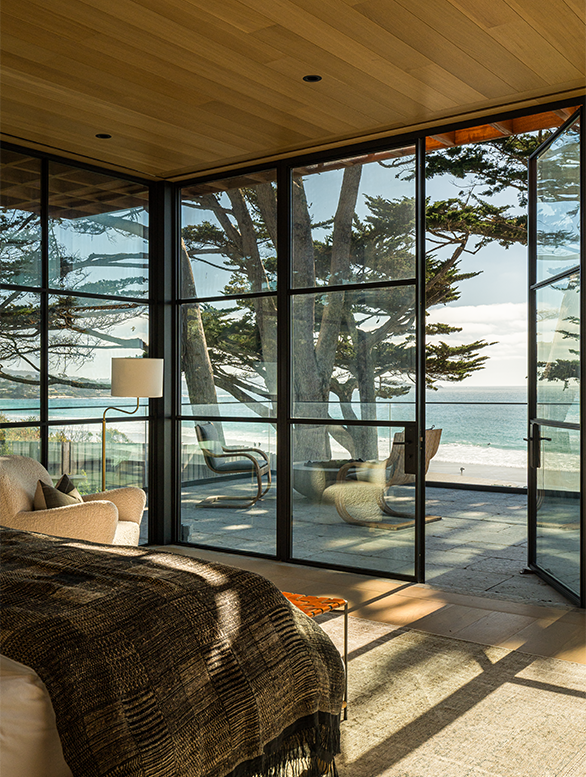

MQ: You have a project in the new book CALIFORNIA COASTAL. Can you tell us about it?
LP: It was designed for a wonderful family from Texas, who have built important buildings all over the world. My clients wanted a pair of houses, one for themselves and one for their children and grandchildren, set on two adjacent lots in Carmel, one facing the ocean and one facing the golf course at Pebble Beach. It was a huge responsibility to get it right, not only for this family but to do justice to the land and the potential of the site. We were lucky to work with an incredible group of people, from each of the consultants to the entire construction team.
MQ: How did you go about it?
LP: We started by developing the idea, the story of these two houses, and engaging with the land. The idea is that living in these houses is a constant conversation with the surroundings, the land, the sea, and the weather. This project really had opportunities and challenges in equal measure—incredible land and views, with height restrictions, setbacks, neighboring properties and owner requirements. How do you live outdoors when it is often cold? What materials do you use when the weather is often harsh? And how do you provide views from every room? It became a creative puzzle. The entire team embraced the challenges, and we couldn’t be happier with the result.
MQ: Life right now is moving so fast. How do you design to slow it down?
LP: I design for step-by-step emotional moments. For example, in a winery, I measure how many steps it takes to arrive at the welcome point, how many to the tasting area, and study what you experience along the way. By carefully orchestrating the experience, we can encourage people to slow down, and take it all in. And it can be done in any situation, on any budget.

MQ: After four years, what is your thinking about building a practice?
LP: I am fortunate to have known everyone in the studio prior to our working together. We are friends first, partners in crime second. I am taking the business of building a practice slowly. I want to learn step by step, and create a business where everyone’s hopes and needs are met, growing when we need to and always keeping my hand in the design.
MQ: It’s so brave to carve your own path, and you’ve done it over and over.
LP: It pushes you to really become yourself. Change requires you define yourself, both to others and to yourself. You have to take a deep look inside. Sometimes, design is the easy part!